
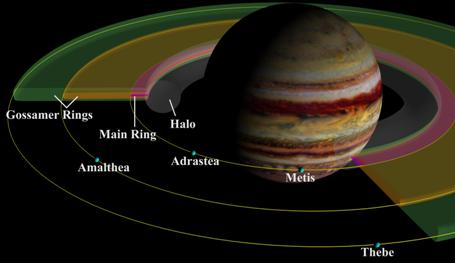
Jupiter is the fifth planet from the Sun and the largest of all the eight planets in our Solar System. Jupiter is two planets away from Earth with Mars being in between the two. Jupiter is classified as a gas giant and has an enormous mass. Jupiter contents consist mostly of hydrogen and helium. Jupiter also has rings around it. There are four rings around Jupiter: The Halo Ring, the Main Ring, the Amalthea Gossamer Ring, and the Thebe Gossamer Ring. Jupiter has at least 63 known moons! The four largest moons are known as the "Galilean Moons" because they were first seen in 1610 by Galileo Galilee. The names of these four moons are Io, Europa, Ganymede, and Callisto. Jupiter's small other moons are thought to be asteroids caught by Jupiter's strong gravitational pull. Jupiter has an orbital period of 4,333 days or 11.86 years. The semi-major axis of Jupiter is 5.2 AU.
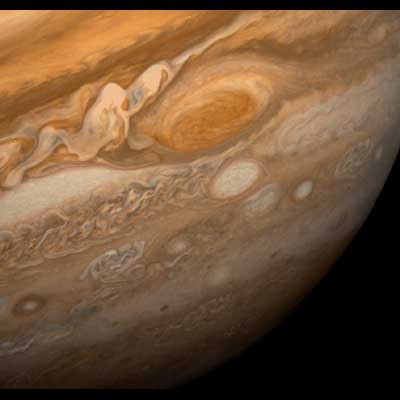
One of the most famous features about Jupiter is its Giant Red Spot which can be seen with a telescope. This happens to be a storm on the surface of Jupiter that has been going on for over 400 years. The storm is so wide that about 3 Earth's could fit inside of the storm.
So How Big is Jupiter?
Jupiter has a huge mass that is about one-thousandth that of the Sun. If you were to combine all the planets masses, Jupiter would have a mass two and a half times larger. You can fit over 1,000 Earth's inside of Jupiter.

Fun Facts about Jupiter
Jupiter is the fastest spinning planet in the Solar System-For all its mass and size, Jupiter makes one rotation every 10 hours.
Jupiter is named after the Roman God who overthrew his father, Saturn to become the King of the Gods.
Jupiter's moon Ganymede is the largest moon in the Solar System.
A 100 pound person would weigh 235 pounds on Jupiter.Find out how much you weigh on Jupiter!
Recent Discoveries about Jupiter
On July 19, 2009 a very unusual event happened on the surface of Jupiter. A mysterious object struck Jupiter leaving behind a dark colored blotch. After this news broke out the Hubble Space Telescope zoomed in on Jupiter to see what the impact looked like in which it looked like a small scar on the lower right of Jupiter. Astronomers came to a conclusion that the impact was from an Asteroid which is a big deal because Asteroids were not known to do this while Comet's were the most likely to make these impacts. Asteroids are usually too small and burn up in the atmosphere before colliding with Jupiter.Astronomers said this was an Asteroid impact because the impact came from something that was heavy and rocky which could not of been a comet because comet's are made of lightweight materials.
The impact was very powerful. The strike was equivalent to the size of a thousands of nuclear bombs exploding. The bruise left on Jupiter is around the size of the Pacific ocean.

For more on this Story:
FEEDBACK
Powered by

This content is neither created nor endorsed by Google.
Report Abuse - Terms of Service - Additional Terms
Report Abuse - Terms of Service - Additional Terms


No comments:
Post a Comment
You can use some simple HTML tags. Off-topic or inappropriate posts will be removed.