Wednesday, November 13, 2013

The Kepler Mission by John Howlette


Overview:
The Kepler Mission, launched on March 7, 2009, is a program implemented by NASA, with the goal of finding potentially life supporting planets within the habitable zone of their parent stars in the Milky Way Galaxy. These planets are being explored with the help of the Kepler spacecraft. So far the Kepler spacecraft has been able to detect thousands of planet candidates, with as many as 40 billion total planet candidates possibly residing within the Milky Way Galaxy. Currently the Kepler Mission is delayed due to a spacecraft malfunction, a new Kepler mission objective is currently being discussed.

Kepler Spacecraft:
The Kepler spacecraft is a space observatory designed and launched by NASA to find Earth-like planets orbiting a parent star. The Spacecraft has a mass of 1,039 kilograms and utilizes a system of strategically placed mirrors for its telescope. It has about a 12 degrees diameter field of view, which is only about the size of ones fist when it is held at arms length. The Kepler spacecraft is able to catch its amazing images with the help of 42 CCDs at 2200x1024 pixels, which at its time of launch, made it the largest camera to be launched into space. Kepler orbits the sun at a height of 1AU and a period of 372.5 days. Kepler points its photometer to a field in the northern constellations of Cygnus, Lyra, and Draco, which assures that light from the sun, earth, and other stray light, doesn’t disrupt the sensitive light detectors of the photometer. Kepler is operated out of the Boulder, Colorado at the University of Colorado.


Kepler Mission:
Other extrasolar planets founds on projects prior to the Kepler mission, were all the size of Jupiter or larger. The Kepler spacecraft is specially designed to look for planets 30 to 600 times less massive, in order to assure that these planets are more to the order of Earth’s mass. The Kepler spacecraft roams the Milky Way Galaxy locating Earth-sized exoplanets within the habitable zone of a sun-like star, such exoplanets are called “Goldilock planets” because they are not too larger or small, or too far or close to their star, but instead just right!   

Discoveries:
Kepler-69c
The method the Kepler spacecraft uses to locate exoplanets is called the transit method of planet finding. This method involves detecting the depletion of light that occurs when a planets passes in front of its parent star. If the object causes these light depletions on a regular basis, it indicates that it is indeed a planets, and the planet’s size can be calculated from the brightness change, and the planet’s orbit and temperature can be calculated from the time between transits. The photometer has the ability to detect a brightness depletion of 1/100 of a percent. http://kepler.nasa.gov/multimedia/Interactives/HowKeplerDiscoversPlanetsElementary/flash.cfm this simulator animates how the Kepler spacecraft detects new exoplanets, and how the information is then transmitted back to Earth. As of now, the Kepler spacecraft has been able to find 167 confirmed earth-sized “goldilock” exoplanets, with thousands of other unconfirmed exoplanets that are still being observed and researched. Scientists have estimated that there are at least 50 billion planets within the Milky Way Galaxy, and at least 500 million of these planets are within the habitable zone of their parent stars. The first Earth-sized exoplanets discovered by the Kepler spacecraft, were announced on December 20, 2011. These planets included Kepler-20e, and Kepler-20f, which orbit within the habitable zone of their parent star Kepler-20. Although, possibly Kepler’s best exoplanets discovery, and one of its most recent, that is a “prime candidate to host alien life” is Kepler -69c. Kepler-69c is 70% larger than Earth is 2,700 light years away in the constellation Cygnus.


Currently:
As of now the Kepler spacecraft is in a state of rest due to the crippling of two of its reaction wheels. In July 2012 wheel 2 of the Kepler spacecraft fail, later on May 11, 2013, wheel 4 of the spacecraft also failed. Due to the loss of the proper functioning from these two wheels, the Kepler spacecraft can no longer continue its current mission of hunting for Earth-sized exoplanets because it no longer possesses the ability to sufficiently point with accuracy using the transit method. A new mission objective for the Kepler spacecraft is currently being discussed, and such mission candidates include searching for asteroids and comets, looking for evidence of supernovas, and finding huge exoplanets through gravitational microlensing.

Conclusion:
With the estimation of 500 million planets within the habitable zone of a star, out of the 50 billion planets within the Milky Way Galaxy zone alone, it appears as though it is very unlikely that there exists no other life elsewhere in the universe, considering that there are 50 billion other galaxies. Theoretically, this provides the potential for one-sextillion Earth-like goldilock planets alone, within the universe. Considering there are at least 30,000 habitable planets within only 1,000 light years of Earth, it is only a matter of time until alien life is discovered.

                              
    FEEDBACK
     
    Commenter name

    What was good about the post?

    How could the post have been improved?

    What do you think would be the best new mission for the Kepler spacecraft?

Learn about Quasars

For his term project presentation, Paul Heinen created a website about quasars. Look through his site and then come back to this page to submit your feedback.


FEEDBACK
    Commenter name  


    What was good about the website?


    How could the website have been improved?


Tuesday, November 12, 2013

Final exam practice questions

Here are my answers to the practice questions. Please let me know if you have questions or spot any mistakes! Don't forget to post requests for review topics by commenting either here or in the previous post.
1.  a,b
2.  e
3.  a
4.  e
5.  1/5 or 0.2
6.  A-D are all "neither."
7.  a shorter; more
8.  b, c
9.  A is twice as far away.
10.  d, e
11.  c
12.  1/40 c = 7.5 x 10^6 m/s away from the second observer and toward the first
13.  The black hole. By definition its escape speed is higher than c.
14.  f > c > a = b > d > e
15.  e (I originally said c, which was incorrect!)
16.  d
17.  a
18.  I got a radius of about 3 m, the height of a basketball hoop off the floor. (Note I originally said 2 m, which was a mistake. Also be aware that I had a typo in the question at first: the number given is the mass of Jupiter, not the Sun. I have now updated the file on Blackboard.)

Good luck with your studying!

Monday, November 11, 2013

Jupiter by Marco Russo


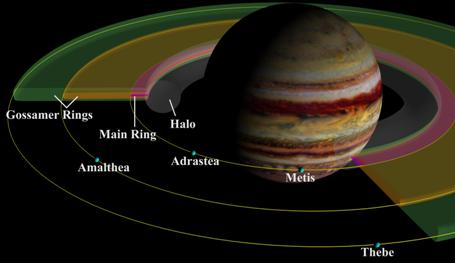
Jupiter is the fifth planet from the Sun and the largest of all the eight planets in our Solar System. Jupiter is two planets away from Earth with Mars being in between the two. Jupiter is classified as a gas giant and has an enormous mass. Jupiter contents consist mostly of hydrogen and helium. Jupiter also has rings around it. There are four rings around Jupiter: The Halo Ring, the Main Ring, the Amalthea Gossamer Ring, and the Thebe Gossamer Ring. Jupiter has at least 63 known moons! The four largest moons are known as the "Galilean Moons" because they were first seen in 1610 by Galileo Galilee. The names of these four moons are Io, Europa, Ganymede, and Callisto. Jupiter's small other moons are thought to be asteroids caught by Jupiter's strong gravitational pull. Jupiter has an orbital period of 4,333 days or 11.86 years. The semi-major axis of Jupiter is 5.2 AU.
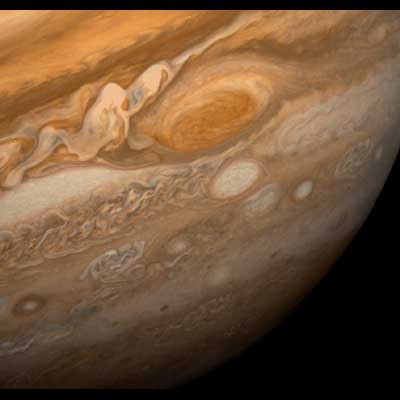
One of the most famous features about Jupiter is its Giant Red Spot which can be seen with a telescope. This happens to be a storm on the surface of Jupiter that has been going on for over 400 years. The storm is so wide that about 3 Earth's could fit inside of the storm.

So How Big is Jupiter?
Jupiter has a huge mass that is about one-thousandth that of the Sun. If you were to combine all the planets masses, Jupiter would have a mass two and a half times larger. You can fit over 1,000 Earth's inside of Jupiter.

Fun Facts about Jupiter
Jupiter is the fastest spinning planet in the Solar System-For all its mass and size, Jupiter makes one rotation every 10 hours.

Jupiter is named after the Roman God who overthrew his father, Saturn to become the King of the Gods.

Jupiter's moon Ganymede is the largest moon in the Solar System.

A 100 pound person would weigh 235 pounds on Jupiter.Find out how much you weigh on Jupiter! 

Recent Discoveries about Jupiter
 On July 19, 2009 a very unusual event happened on the surface of Jupiter. A mysterious object struck Jupiter leaving behind a dark colored blotch. After this news broke out the Hubble Space Telescope zoomed in on Jupiter to see what the impact looked like in which it looked like a small scar on the lower right of Jupiter. Astronomers came to a conclusion that the impact was from an Asteroid which is a big deal because Asteroids were not known to do this while Comet's were the most likely to make these impacts. Asteroids are usually too small and burn up in the atmosphere before colliding with Jupiter.Astronomers said this was an Asteroid impact because the impact came from something that was heavy and rocky which could not of been a comet because comet's are made of lightweight materials.
The impact was very powerful. The strike was equivalent to the size of a thousands of nuclear bombs exploding. The bruise left on Jupiter is around the size of the Pacific ocean. 

For more on this Story:


FEEDBACK
    Commenter name

    What was good about the post? *

    How could the post have been improved?

    To what extent did you find the presentation clearly organized and enjoyable to read?

The Extrasolar Worlds of the Milky Way Galaxy

Will Buchman

An extrasolar planet can be defined as a planet located outside of our solar system. It is believed that there are between 100-400 billion exoplanets in the milky way galaxy. The discovery of exoplanets is actually relatively new, the first confirmed discovery of an exoplanet didn't actually happen until 1988! However, this is not considered to be the first definitive discovery of an exoplanet, this title belongs to an event that occurred in 1992. Two extrasolar planets were discovered orbiting a pulsar by radio astronomers Aleksander Wolszczan and Dale Frail. This discovery was so influential because it basically removed all doubt concerning the existence of exoplanets. This is the original press release regarding that event. Since these initial findings, the discovery rate of extrasolar planets has boomed. As of November 4th this year, more than 4,000 exoplanet candidates have been discovered. Even with all these new discoveries, we still don't know a whole lot about exoplanets. In fact, only a few months ago, NASA determined the true color of an exoplanet for the first time.


The picture above is a comparison of Earth and an artists rendering of what the famous exoplanet Gliese 581g may look like. Believe it or not, this picture is actually based in real science, artists must use information regarding exoplanets in order to determine their possible size and color. This video describes the process in more detail

There are many different processes by which exoplanets are discovered. A lot of these techniques have only been successfully used once or a few times. There are a few methods that are used quite a bit, including the transit method, the radial velocity method, and gravitational microlensing. These methods are employed because it simply isn't possible to directly image most exoplanets, only a few extrasolar planets have been found through direct imaging.

The transit method:
The way planets are identified through the transit method is by observing their star. When a planet crosses in front of its parent star, the observed brightness of said star will drop ever so slightly. A candidate must be observed transitting its star several times before it can be confirmed to be an exoplanet. This technique can be used to determine a planets radius, by measuring the amount that the star dims during transit. The transit method is far from the perfect method. For example, an exoplanet's orbit must be perfectly lined up with the observing point, many possible planets could slip through the cracks using this method. Another major flaw is that plenty of other things could cause a star's brightness to dip, there could be a high number of false detections as a result of this method.


The radial velocity method:
As you know, everything in the universe has its own gravitational force. This means that planets are exhibiting a gravitational pull on their stars. Ergo, a star with a planet will move in a small orbit in response to its planet's force of gravity. This effect can be seen in the animation below.


By measuring these wobbles, astronomers can calculate whether or not a star has a planet. This way of detecting exoplanets has proven to be exceptionally successful. However, as with all techniques, it has its flaws. Multi-planet and multi-star systems can give mixed results, which can lead to false positives. Another flaw of this technique is that it is difficult to use on stars with higher mass, seeing as how a planet's gravitational force will have much less effect on a supermassive star as opposed to a lower mass star. Despite these flaws, this method is still the most productive technique.

Gravitational microlensing:
In this class we learned that gravity can have an effect on light, this technique measures that effect. When light passes through the gravitational field of a star, it can potentially act as a lense, magnifying background light. In this case, a distant star. This technique is unique in that it is most efficient at detecting planets that have a smaller orbit. In fact, it was the first method used to detect Earthlike planets orbiting around main sequence stars like our own. There is one significant problem with gravitational microlensing. The lensing effect only occurs when two stars are exactly aligned, these events do not last long, and most notably, they do not repeat. This is an enormous disadvantage, it is impossible to observe this effect after it is over, meaning that it is harder to determine whether a candidate is a true extrasolar planet or not.


Now you may be asking yourself, how does this effect me? Why should I care about exoplanets? Well these discoveries actually have a number of direct impacts on us. For example, exoplanets likely hold the answer to the age old question, "are we alone in the universe?" Astronomers predict that there are more than 10 billion habitable Earthlike planets in our galaxy alone, what are the odds of life not developing on any of them? With all these discoveries, it is believed that it is no longer a matter of if we find a true Earth analogue, but when. Not only are exoplanets the key to understanding life in the universe, but they are also likely to play an important part in the future of mankind. With modern technology, colonizing exoplanets is but a pipe dream, but if humans want to survive, we will eventually have to leave Earth and find a new home. Therefore, it is of the utmost importance that we learn as much as we can about exoplanets.

    FEEDBACK

    Commenter name


    What was good about the post?


    How could the post have been improved?


Sunday, November 10, 2013

Last week of class!

I'm back in Denver! Here's a nice astro-photo I took from the plane last week, somewhere over New York. Can you see two celestial objects?

Hint: look to the lower left of the Moon, about half the
distance to the tip of the wing. Anyone know what it is?

Can you believe the quarter's over already? Those ten weeks go by like lightning. This week we will have several term project presentations, practice with the Doppler shift equation on Tuesday, and review for the final exam on Thursday. Here's your chance to request specific topics to review.

Remember, the final will be cumulative, so you will need to study concepts from the first part of the class as well as more recent material. However, you all did so well on the midterm that I will focus primarily on the topics from the last half of the class. The final will also be slightly more challenging than the midterm, because you've shown you can handle it. Don't worry, this doesn't mean "impossibly hard"! There will be lots of straightforward questions. If you are comfortable with all the homework and in-class work we've done this quarter, you will do fine on the exam.

So what should we talk about in the review session?

Saturday, November 9, 2013

Extrasolar Planets by Paul Dohm


An extrasolar planet-which I will call an exoplanet from here on-is a planet that exists outside of the solar system.  For years, exoplanets were merely hypothetical, with astronomers dating back to Newton and beyond, postulating on their existence; but there was no proof that they existed.  The search for exoplanets promises not only extending scientific knowledge of the universe, but also, with a more existential flavor, the answer to that mighty question: are we alone in the universe?  With hundreds of billions of stars in just the Milky Way, not even considering the other billions of galaxies in the universe, there are an estimated 100-400 billion exoplanets in the galaxy.  In 1988, the first exoplanet was discovered using a radial velocity technique.  The planet, Gamma Cephei Ab, was not confirmed until 2002, however it can claim the honor of being the first exoplanet discovered.  Gamma Cephei Ab is around 45 light years from Earth-making it relatively close compared to most exoplanets.  This planet is between 2 and 16 times more massive than Jupiter.  Since the discovery of Gamma Cephei Ab in 1988, scientists have confirmed 919 planets outside of the solar system.  So far, the most clearly observed and evidenced exoplanets divide into three types: gas giants, hot super-Earths, and ice giants.  The hunt is on for a fourth type of exoplanet: terrestrial planets-that is a planet one half to 2 times as massive as Earth and located within the habitable zone, which we will discuss further later on in the blog post. 
                                                     

Scientists use different techniques to detect and confirm an exoplanet.  Such techniques include but are not limited to: doppler shift, astrometric measurement, transit, direct imaging, and gravitational microlensing.  Now we won't go into these techniques in detail, for want of time and a more qualified instructor, but it is useful and enlightening to keep in mind that multiple methods and disciplines are incorporated into the search for exoplanets.  One of the most famous and successful missions in the search is the now decommissioned Kepler Space Telescope, with which astronomers were able to confirm 156 planets, and identify another 3602 candidates.  Kepler uses planetary transits to detect exoplanets.  As we all know, a transit occurs when a planet crosses in front of its star.  When a planet transits its star, it causes a small dip in the star's brightness-a change of about 100 parts per million.  This tiny change is detectable by Kepler, and since orbits are periodic, astronomers can observe the star over time and see if the planet really is a planet.  Now that the planet is detected, astronomers can use Kepler's Third Law to calculate the period and mass of the planet.  They can then in turn use this information to calculate the size and temperature of the planet.  Thus far, the count for confirmed exoplanets goes as follows: Stars with Planets 712; Multi-planet Systems 145; Gas Giant 407; Hot Jupiter 432; Super Earth 70; Terrestrial 13; Unknown 9.  The 13 terrestrial planets all lie within the habitable zone.  The habitable zone, sometimes referred to as the "goldilocks zone" is the distance from a star in which a planet could potentially harbor life.  Now we're getting into some interesting stuff; the continuing discovery of more and more planets in the habitable zone only strengthens the argument that we are not alone in the universe.  Only a few days ago, on November 5, a NASA report (using Kepler data) estimated that at least one in five stars in the Milky Way have at least one planet that is Earth-sized and located within the habitable zone.  If you feel your mind being blown, that's okay, it is only natural.  This means that if you look up at the stars at night, the nearest star with the possibility of a planet is only 4 light years away and is visible; you could see a star with terrestrial planets and potentially life.  It is discoveries like this that drive the hunt for exoplanets.  The human thirst for answers, a thirst that led to the discovery of fire, a thirst that led to the discovery of the Americas, a thirst that led to the discovery of manned flight, will in time lead to the discovery of life in the universe.

FEEDBACK
    Commenter name

    What was good about the post?

    How could the post have been improved?

    To what extent did you find the presentation engaging?

Thursday, November 7, 2013

The Moons and Rings of Saturn

Picture taken from Voyager. The colors are to depict
different chemical make-up of the rings. 

Hallie Stolte 
Picture from NASA Cassini Mission


Overview
Saturn is a gas giant that is the second largest planet in our solar system after Jupiter. It is mostly known for its incredible rings. There are 53 confirmed moons and 9 potential moons. The Saturn system is very complex because the moons orbit with in the rings and are an integral part of ring system. Some of the moons are called "shepherd moons" because they orbit within the rings and interact in a way that causes the ring material to be guided into a certain position. The Cassini mission was launched in 1997 and has recently discovered a lot about the moons and rings of Saturn. Part of the mission was to drop a probe on to one of Saturn's moons, Titan. This has lead to many discoveries about Titan. One important discovery is how similar is is to Earth. Scientist are using Titian to model the early stages of Earth’s development.


Enceladus
Enceladus is one of Saturn’s moons located in Saturn’s outermost ring (the E-ring). It has recently become and important moon because of the Cassini mission. Uniquely, this moon is known for it its icy volcanic activity. The Cassini mission discovered that this icy material was contributing to the formation of the E-ring. The material comes from under the surface of the moon and is ejected out into the atmosphere of the moon and even ejected beyond the atmosphere. The material that doesn’t leave the atmosphere falls back to the moon like snow, and the material that does escape contributes to the material in the E-ring. Following this discovery, the Cassini mission discovered that some of the E-ring material contained sodium salts. It was then theorized that the jets of Enceladus came from a liquid source that lay under the surface of the moon. The sodium salts gave way to the idea that this liquid source was actually a salt-water ocean.


Rings
Galileo first saw the rings of Saturn in 1610. The rings were named using alphabetical letters as they were discovered. Each ring orbits at a different speed around Saturn because of Kepler’s third law. Each ring also has its own unique make up and density. The rings span about 200 times the diameter of Saturn. They are composed of frozen material that originated from of asteroids, dust, and broken moons. Before the Cassini mission, “ghostly” shadows were spotted on the rings. These shadows are called spokes and have just recently started to be understood with the Cassini mission. The spokes form in a matter of minutes and only last for a few hours. They are still not well known, and scientists hope to learn more about their cause with Cassini.


Questions: (To answer some of these questions you will have to explore the links above)

What is the order of the rings starting with the ring closets to Saturn?
a.    A, B, C, D, E, F, G
b.    G, F, E, D, C, B, A
c.    D, C, B, A, F, G, E
d.    C, A, F, G, D, B, E

Which is not true regarding the moons of Saturn? (Use this link)
a. Titan is so massive that its gravity affects other moons orbits
b. Some of the moons orbit in the opposite direction as everything else.
c.  Half of Lapetus is very dark while the other side is very bright.
d.  Titan is the largest moon in the solar system

Which statement about Enceladus is not true?
a.  Its jets contribute to the formation of Saturn's E-ring
b.  It is located in the E-ring
c.  It might have a salt-water ocean beneath its surface
d.  It has eruptions of icy material
e. All statements are true

In the mosaic infrared mapping of Titan there are orange spots. What do these represent?
a. Lakes
b. Volcanic activity
c. Evaporated Material
d. Bedrock of water and ice

When were the spokes first seen? (use this link)
a.  In 1997, when the Cassini was launched
b.  In 2004, when Cassini began to orbit
c.  In 1979, with the pioneer
d.  In 1981, with the Voyager 2 flyby

Browse the gallery in the NASA website. What is the rose?
a. An anomaly on Saturn’s B-ring
b. A vortex on Saturn’s pole
c. A dust cloud in the Saturn system
d. A storm on Titan


FEEDBACK

Please offer your constructive feedback on this blog post.  Your comments will be sent to Dr. Hoffman and she will summarize them anonymously for Hallie.
    Commenter name


    What was good about the post?


    How could the post have been improved?


    How easy was it to find the information for the quiz?